Introduction
The United Kingdom remains one of the most prestigious and accessible jurisdictions for international entrepreneurs seeking to expand their global footprint. With its robust legal framework, competitive tax environment, and position as a global financial hub, London and the wider UK market offer unparalleled opportunities. One of the most significant advantages for international business owners is that the UK government does not impose residency requirements for company directors or shareholders. This means that as a foreigner, you can fully own and manage a UK Limited Company (LTD) without ever setting foot on British soil. This guide provides an in-depth exploration of the legal requirements, procedural steps, and ongoing compliance obligations involved in setting up a UK entity from abroad.
Understanding the UK Limited Company Structure
A Limited Company is a distinct legal entity, separate from the individuals who own or manage it. For a foreigner, the ‘Private Company Limited by Shares’ is the most common choice. Its primary benefit is limited liability, which protects the personal assets of the owners if the business encounters financial difficulties. This separation between the company and its directors is a cornerstone of English law, providing a secure environment for high-stakes international trade.
The Legal Eligibility for Non-Residents
To the surprise of many, there are virtually no restrictions based on nationality or residency for incorporating a UK company. Any person of any nationality can be a director, provided they are over the age of 16 and have not been previously disqualified from acting as a company director. However, while the people can be located anywhere, the company itself must be physically ‘registered’ in the UK.
Key Requirements Before Incorporation
Before initiating the registration process with Companies House (the UK’s registrar of companies), several key components must be finalized:
1. Company Name: The name must be unique and not ‘too like’ an existing name. It must end with ‘Limited’ or ‘Ltd’. Certain sensitive words (e.g., ‘British’, ‘King’, ‘Insurance’) require specific permission from the Secretary of State.
2. Registered Office Address: This is a legal requirement. The address must be a physical location in the UK (England and Wales, Scotland, or Northern Ireland) where official mail can be delivered. Many foreigners use ‘Virtual Office’ services or their accountant’s address to satisfy this requirement.
3. Directors and Shareholders: You need at least one director (an individual) and one shareholder (who can be the same person or a corporate entity). You do not need a company secretary for a private limited company, though you may choose to appoint one.
4. Standard Industrial Classification (SIC) Code: You must identify your business activities using one or more SIC codes provided by the government.

Step-by-Step Process to Open Your Company
Step 1: Choosing a Formation Method
You can register directly via the Companies House website, which is the most cost-effective method (currently £50 for online registration). Alternatively, you can use a professional formation agent or an accountant. For foreigners, agents are often preferred because they bundle the registration with a registered office address and international mail forwarding services.
Step 2: Preparing Constitutional Documents
Every UK company must have two primary documents:
- Memorandum of Association: A legal statement signed by all initial shareholders confirming their intention to form the company.
- Articles of Association: The ‘rulebook’ for the company, outlining how it will be governed, how shares are transferred, and how decisions are made. Most companies adopt the ‘Model Articles’ provided by the government, but bespoke articles can be drafted for complex share structures.
- Annual Accounts: Financial statements showing the company’s performance.
- Confirmation Statement: An annual update to Companies House confirming that the information they hold about your directors, shareholders, and registered office is correct.
- Company Tax Return (CT600): Submitted to HMRC to calculate your tax liability.
Step 3: Submission to Companies House
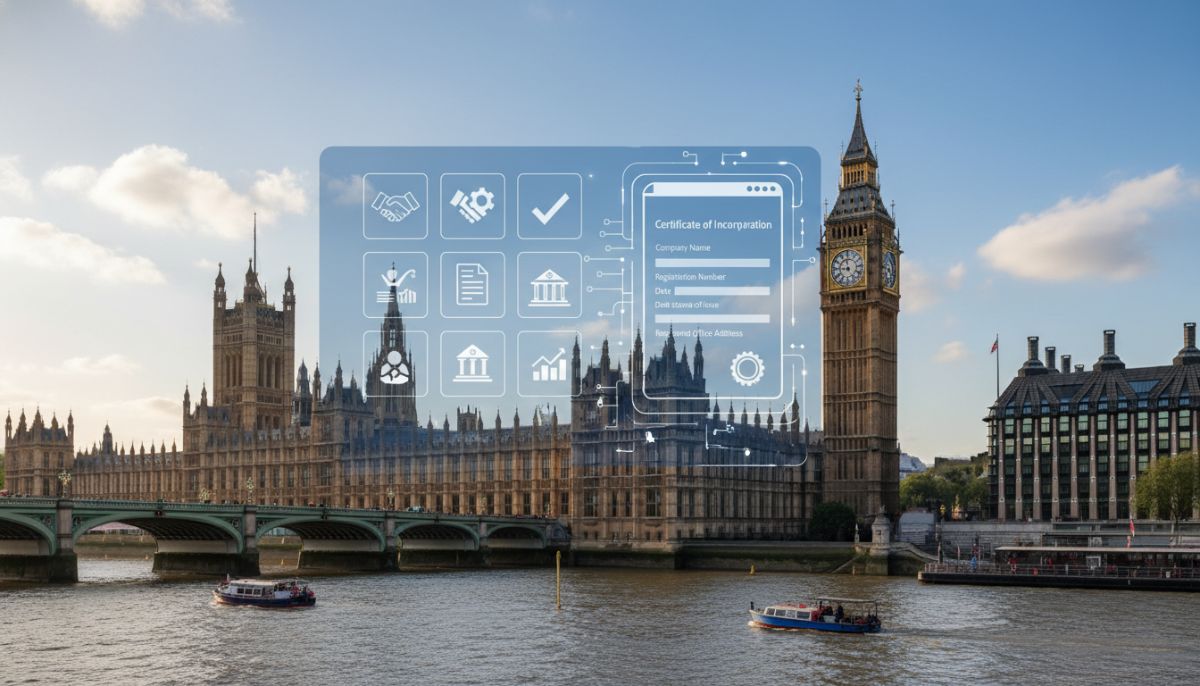
Once the application is submitted, Companies House typically processes the incorporation within 24 to 48 hours. Upon approval, you will receive a Certificate of Incorporation, which serves as the legal ‘birth certificate’ of your company, containing your unique 8-digit Company Registration Number (CRN).
The Banking Challenge for Foreigners
While registering the company is relatively simple, opening a traditional high-street UK bank account (such as with Barclays, HSBC, or Lloyds) as a non-resident is notoriously difficult. These banks often require at least one director to be a UK resident to satisfy ‘Know Your Customer’ (KYC) and Anti-Money Laundering (AML) regulations.
The Solution: Digital Banks and EMIs
Most foreign entrepreneurs now turn to Electronic Money Institutions (EMIs) or digital-first business platforms like Wise, Revolut Business, or Airwallex. These platforms allow you to obtain a UK sort code and account number without a UK residency, provided you can prove the legitimacy of your business and provide valid identification (passport).
Taxation and Financial Compliance
Operating a UK company brings specific tax obligations to HM Revenue and Customs (HMRC).
Corporation Tax
All UK companies must pay Corporation Tax on their global profits. As of 2024, the rate is tiered between 19% and 25% depending on profit levels. You must register for Corporation Tax within three months of starting to trade.
Value Added Tax (VAT)
If your company’s taxable turnover exceeds £90,000 in a 12-month period, you must register for VAT. Once registered, you must charge VAT on your sales and can reclaim VAT paid on business expenses. Voluntary registration is also possible for businesses below the threshold, which can add a level of professional credibility.
Annual Filings
Every year, your company must file:
Conclusion
Opening a Limited Company in the UK as a foreigner is a strategic move that provides access to one of the world’s most stable and reputable business environments. While the incorporation process itself is streamlined and digital, the real work lies in maintaining compliance and navigating the complexities of international banking and taxation. By securing a UK registered address, utilizing digital banking solutions, and ensuring timely filings with Companies House and HMRC, international entrepreneurs can successfully leverage the ‘UK Brand’ to scale their enterprises globally. It is always recommended to consult with a UK-based tax advisor to ensure your corporate structure is optimized for both UK and your home country’s tax laws.
Leave a Reply